
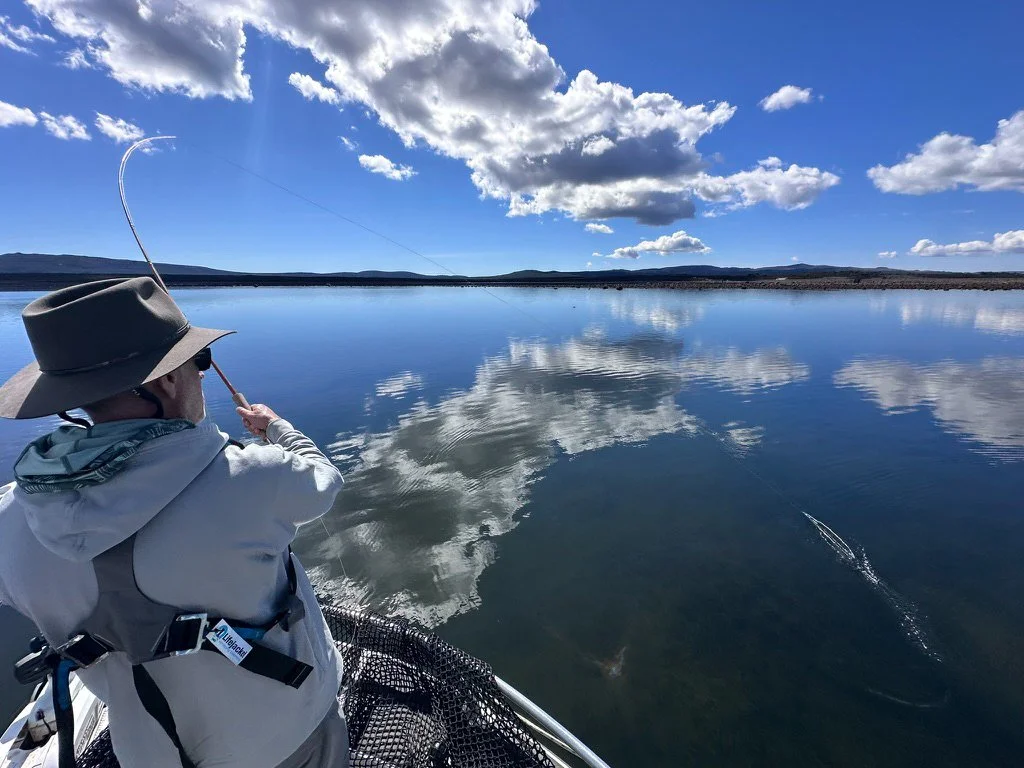
Why short-line fly fishing can turn casting time into catching time
Credit where credit’s due: this one is courtesy of Tasmanian fishing legend “Stopper” from Tas High Country Fly Fishing Tours. The adage, “less swish, more fish”, neatly sums up one of the most useful lessons in dry fly fishing in Tasmania. It is easy to fall into the rhythm of false casting, waiting for the perfect moment to present the fly. But the truth is blunt: if your fly is not on the water, you are not fishing.
A trout is unlikely to launch ten feet into the air to take a fly, no matter how pretty your loop looks. Every second your fly spends in the air is a second it cannot be eaten. If it is off the water half the time, you have effectively halved your fishing time. That is why a simple pick-up-and-lay-down presentation, especially with a shorter line, can be so effective.
The Short-Line Advantage
Fishing a short line means less time waving graphite or glass around and more time with the fly working where it should be: on the surface. It also lets you cover more fish more efficiently. As the boat is drifting with the wind, trout are feeding into the wind, travelling towards the boat, a short line gives you room to lengthen your cast rather than frantically trying to shorten up. That small difference can turn a rushed opportunity into a clean presentation.
Read the Drift
At its heart, this approach is about managing the drift of the fly in relation to the surface and the wind. If your fly is moving faster or slower than the water around it, a trout will usually refuse it - end of season battle-hardened Penstock Lagoon Brownies I’m looking at you. You may fool the odd careless fish, but the odds are already swinging back in the trout’s favour.
With a short line, you can see your fly clearly and compare its movement with bubbles, foam lines, or floating food nearby. These little reference points tell you when the drift has gone wrong. The instant your fly begins to behave differently from the surface around it, pick up and recast. Sometimes that moment comes after ten seconds; sometimes it may be thirty. Either way, if you can see the difference, you can be sure a trout can too.
What “Short” Really Means
A practical short-line setup might put only about three feet of fly line outside the rod tip. Add a nine- or ten-foot rod, around nine feet of tapered leader, and a couple of feet of tippet, and suddenly you are still fishing roughly twenty-seven feet from your position in the boat. In other words, short line does not mean fishing under your feet. It means fishing at a distance you can control.
And do not worry too much about the boat. Fish are not automatically terrified of it. The next trout to eat an errant fly blown from the deck two feet from the gunwale will be neither the first nor the last.
Working the Boat
Picture the boat set up with the wind at your back and the drogue trailing behind to slow the drift. One angler works from each end while the guide occupies the middle, dodging fly lines and, on a bad day, the occasional hook. A safety reminder belongs here: always wear sunglasses when fly fishing. A hook in the skin is manageable; a hook in the eye is a trip to the Emergency Department.
As the boat drifts with the breeze, both anglers cast along the long axis of the boat, roughly ninety degrees to the wind. Fish approaching from downwind will often be swimming towards the boat into the breeze, so your cast needs to land shorter than the place where you last saw the trout rise. It takes practice, and it certainly helps to have eyes that work like a chameleon’s: one watching the water beside the boat and the other scanning downwind for movement.
Keep a manageable amount of fly line at your feet so you can fire a cast quickly when a trout appears. Check it often. Make sure it is not wrapped around a boot, bag, dog, or any other piece of boat clutter. One of the quiet benefits of short-line fishing is that it is difficult to cast while shortening line, but easy to add distance when the line is already short.
Turning Fishing Time into Catching Time
It can take a while to trust a short line, and longer still for long-line devotees to convert. But once you see how much more controlled, responsive, and efficient this style of fishing can be, it is hard to go back. You will cover more fish, present the fly more naturally, and spend far less time casting at empty air. In the end, “less swish, more fish” is not just a catchy saying. It is a practical way to tilt the odds towards the angler and turn fishing time into catching time.
